Youth Wide Receiver Training Starts With Catching the Ball, Not Routes

I’ve coached a lot of young receivers who can run around cones, do fancy footwork, and look sharp in drills...until the ball shows up.
Then the truth hits fast: nothing matters if you can’t catch.
At the youth and middle school level, wide receiver training has to be simplified. Not watered down, just focused. The goal isn’t to memorize a route tree. The goal is to build a player who can track the ball, catch it clean, change direction with balance, and finish the play with intent.
That’s the foundation we build at Command Football Academy.
1) Catching Comes First. Because the Ball Decides Everything
A receiver’s job is simple: secure the ball. If that doesn’t happen, the rest of the “skills” are noise.
Youth athletes don’t need 12 routes. They need:
Reliable hands
Calm eyes
Strong catch mechanics
Reps that build confidence
We spend time on hands position, timing, and body control, because catching is not a talent you “either have or don’t.” It’s a skill that improves with correct reps, over time.
And the earlier a kid starts training hand-eye coordination, the bigger the payoff later.

2) Hand-Eye Coordination Is a Long Game. Start Now
This is where baseball players quietly have an advantage. Kids who grew up tracking a small ball, judging flight, and reacting under pressure often transition well to receiver play.
They’ve already built a nervous system that can:
Pick up the ball early
Track it through space
Time the hands to the moment
Stay composed when the ball arrives
That same ability can be trained in football, especially when we stop rushing kids into “route running” before they’ve earned the right to call themselves dependable.
We do this with progressive catching progressions:
Stationary catches to build mechanics
Moving catches to build timing
Angle catches to build body control
Reaction catches to build real hand-eye skill
It’s not glamorous. It’s just effective.

3) Change of Direction: Move Well Before You Move Fast
A lot of youth “receiver training” turns into speed work that ignores movement quality.
But most drops and missed plays aren’t just hands, they’re poor body position. Kids are off balance, late to the spot, or drifting.
So we build COD (change of direction) with simple standards:
Low hips, quiet shoulders
Stick the foot, don’t spin
Re-accelerate with intent
Eyes stay up—because football is played with vision
A receiver who can stop and start clean will separate more often, even without fancy routes.
4) Releases: Win the First Two Steps
Releases at this age don’t need to be complicated. Youth DBs and linebackers are learning too. But the first two steps still matter because that’s where confidence is built.

We keep releases simple:
Alignment and stance (start in control)
One move, then go (no dancing)
Use the hands with purpose—not panic
Learn to stay vertical and stack space when it’s there
Most young players don’t need more moves. They need one or two that they can execute under pressure.
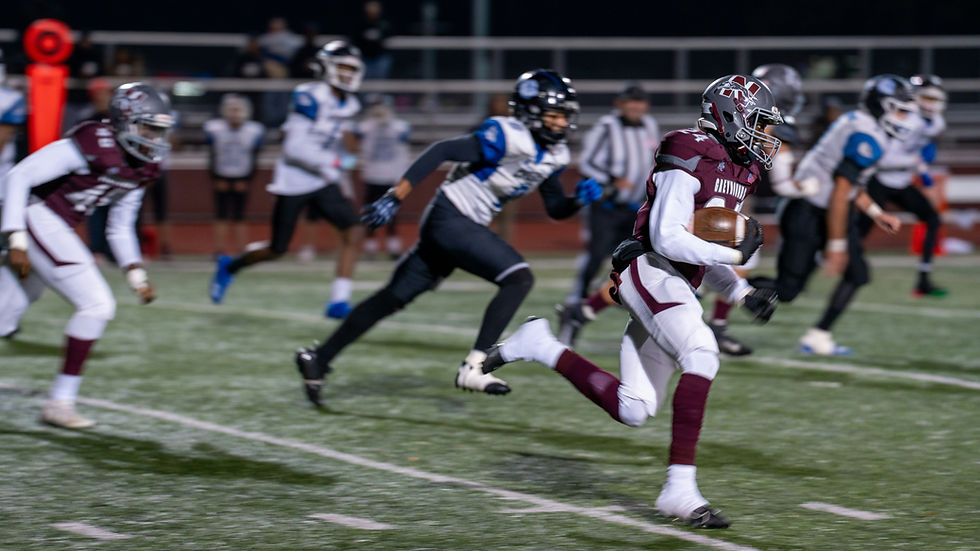
5) Run After Catch: Turn Catches Into First Downs
Once a player can catch reliably, we train what comes next because a youth receiver who can turn a 6-yard catch into 16 changes the game.
Run-after-catch is where athleticism meets decision-making:
Secure first, then accelerate
Get vertical when it’s clean
Make one defender miss (one move)
Finish forward, protect the ball
I want young receivers thinking like football players, not track athletes. Speed matters, but so does judgment.
6) Route Concepts Come Later...After the Player Can Actually Play
Route concepts matter. Timing matters. Spacing matters.
But here’s the problem: if a kid can’t catch, can’t stop and start, and can’t handle contact
at the top of a route, then installing route concepts early just creates confusion.
So we earn it in phases.
At the youth and middle school level, we prioritize:
Catching and tracking
Hand-eye coordination under movement
Change of direction fundamentals
Simple releases and separation
Run after catch and ball security
Then, once movement and hands are consistent, we layer in concepts like spacing, leverage, and route intent. That’s when the “route tree” actually means something—because the athlete can execute it.
Final Thought
I’m not interested in turning a 12-year-old into a highlight reel. I’m interested in building a receiver who can be trusted: on third down, in traffic, with a defender closing, when the game speeds up.
The players who separate later aren’t always the ones who learned the most routes early.
They’re usually the ones who mastered the basics and stayed patient long enough for those basics to compound.
Catch first. Run. Score.
Keep mastering the basics.
About Me - Jay Glaspy

I’m a U.S. Army Special Forces Veteran and youth football coach who now leads with a different mission—developing young athletes here in Northern Virginia. As the founder of Command Football Academy, I help kids get faster, stronger, and more confident through effective coaching built for their age and experience level.
My coaching approach blends football fundamentals, speed development, and character-building. We train for football, but we’re really preparing for life—teaching discipline, leadership, resilience, and teamwork. Every athlete who trains with CFA becomes a better football player and a stronger, more confident young person—on and off the field. Connect here -> contact@commandfootballacademy.com


Comments