Football Conditioning vs. Speed Training: Why Gassers Are Slowing Your Players Down
Updated: Nov 16, 2025
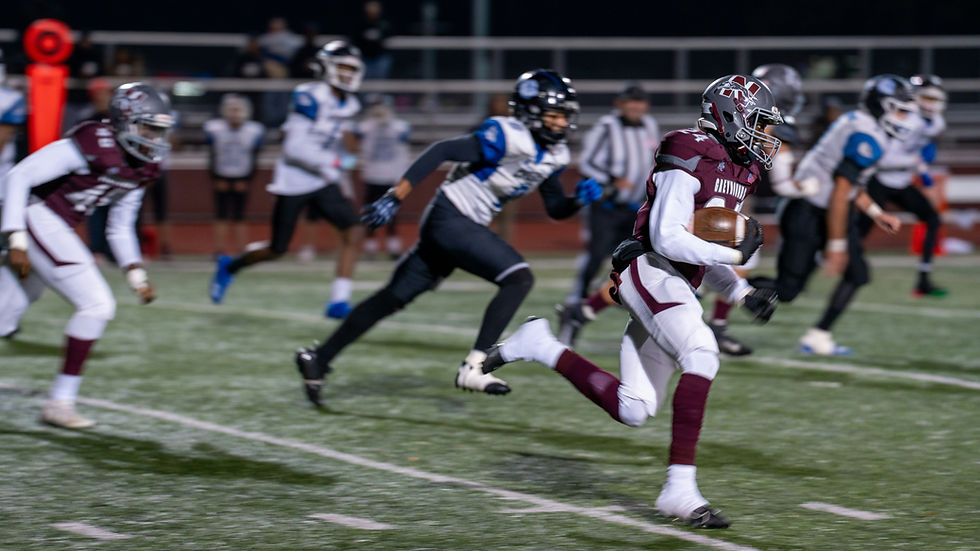
Stop Running Laps—Start Training for Speed
For years, football conditioning has been built around running gassers, suicides, and endless laps to “get in shape.” Coaches believe these drills build mental toughness and endurance, but the truth is, they’re actually making players slower, weaker, and more injury-prone.
Football is a game of speed, not endurance. Plays last 4-6 seconds, followed by 20-30 seconds of rest. Yet, many coaches still train players like they’re preparing for a cross-country race instead of an explosive, power-based sport.
Elite athletes like Christian McCaffrey, one of the most dynamic and explosive football players in the NFL, don’t train with long, exhausting conditioning workouts. Instead, McCaffrey trains under Brian Kula, a speed performance expert who emphasizes short, high-intensity sprints, power training, and full recovery to maximize explosiveness and keep him fast and healthy all season long.
Are you training your players to be fast—or just tired?
The Problem With Traditional Football Conditioning
If you've ever made your players run gassers at the end of practice, ask yourself this: Did they actually get faster?
🚫 Gassers Teach Players to Run Slow
Running long distances at 70-80% effort teaches the body to move at a lower speed—which translates to less explosiveness on game day.
Over time, slow training becomes muscle memory, making it harder to develop real speed.
🚫 Endurance Running Kills Fast-Twitch Muscle Fibers
Football is an anaerobic sport, meaning it relies on short bursts of power and speed.
Long-distance running recruits slow-twitch muscle fibers, which reduces acceleration and explosiveness.
🚫 Fatigue = More Injuries, Not More Toughness
Overworked players are less explosive, less reactive, and more prone to muscle strains and joint injuries.
Mental toughness doesn’t come from exhaustion—it comes from executing plays at full speed under pressure.
🚨 Bottom Line: If your team is always tired, they’re always slow. Speed wins football games—not endurance.
How Brian Kula Trains Christian McCaffrey for Speed & Durability
Brian Kula, the performance coach for Christian McCaffrey, has built a training system focused on explosiveness, recovery, and speed efficiency. Instead of gassers, long-distance running, and exhaustion-based training, Kula’s program focuses on:
✅ Max-effort sprint training to build game-speed explosiveness.
✅ Power and strength training without over-fatigue to maintain peak performance.
✅ Full recovery between reps to ensure each sprint is high quality and game-speed fast.
McCaffrey is known for his elite acceleration, agility, and injury resilience—all of which are the result of training smarter, not harder. If your team is still doing endless conditioning instead of training for speed, you're falling behind.
The Right Way to to Train Speed and Conditioning Football Players
If gassers and excessive running don’t work, how should players train? Sprint-based conditioning.
Tony Holler’s Feed the Cats philosophy and Brian Kula’s training approach both emphasize:
Sprint fast. Rest fully. Repeat.
Never train to exhaustion—train for speed.
Measure sprint times to track improvement.
Instead of punishing players with slow, tired running, we need to train like the fastest athletes in football—with short bursts of max effort, proper recovery, and measurable progress.
Sprint-Based Training vs. Traditional Conditioning for Football
Traditional Conditioning | Sprint-Based Training |
Slow, fatigued running | Explosive, high-speed sprinting |
No measurable improvement | Timed sprints to track progress |
High injury risk | Lower injury risk with proper recovery |
Trains endurance (which isn't needed) | Trains speed (which wins games) |
🚀 In football, the fastest team wins. You can’t be fast if you’re always exhausted.

The Right Speed Training Plan for Football Players
To condition players the right way, focus on speed, power, and recovery instead of slow endurance work.
1️⃣ 10-Yard & 20-Yard Sprints (5-6 Reps)
Why? Acceleration is more important than endurance in football.
Rest: 45-60 seconds between reps to maintain max effort.
2️⃣ Flying 30s (4 Reps)
Why? Develops top-end sprinting speed.
Rest: 1.5-2 minutes between reps for full recovery.
3️⃣ 5-10-5 Shuttle Drill (4 Reps)
Why? Improves change of direction & reaction time.
Rest: 30-45 seconds between reps.
4️⃣ Bounding & Plyometric Jumps (3 Sets of 5 Jumps)
Why? Builds explosive power & stride length.
5️⃣ Full Recovery = Faster Players
No extra laps or unnecessary running.
Monitor sprint times to measure improvement.
🚀 Train speed. Track speed. Never train slow.
Why Our Training Works (And How We Can Help)
At Command Football Academy, our coaches are certified personal trainers and sports performance coaches and understand the difference between conditioning and speed training for football. We use science-backed speed training methods to develop faster, stronger, and more explosive football players—without running them into the ground.
✅ Sprint-Based Training – Short bursts of speed with full recovery.
✅ Strength & Power Development – Focus on explosiveness, not fatigue.
✅ Football-Specific Conditioning – Drills that translate directly to the game, not just aimless running.
If you want your athlete to get faster and dominate on the field, let us train them the right way.
About Us
Command Football Academy was founded by Coach Jay Glaspy, a retired U.S. Army Special Forces Veteran, youth football coach, NASM-certified personal trainer, and speed coach committed to developing high-performing athletes.
With more than 25 years of leadership and coaching experience in various industries, Coach Glaspy effectively combines a deep understanding of mental performance, youth athletic development, and position-specific football training. Academically, he holds a Master’s in Organizational Leadership and a Bachelor’s in Psychology, bringing a holistic approach to athletic performance and personal growth.
At Command Football Academy, we coach youth and high school football players to perform with purpose, master the basics, and compete with confidence—developing skills that elevate performance both on the field and in everyday life.
Contact Us: contact@commandfootballacademy.com


Comments